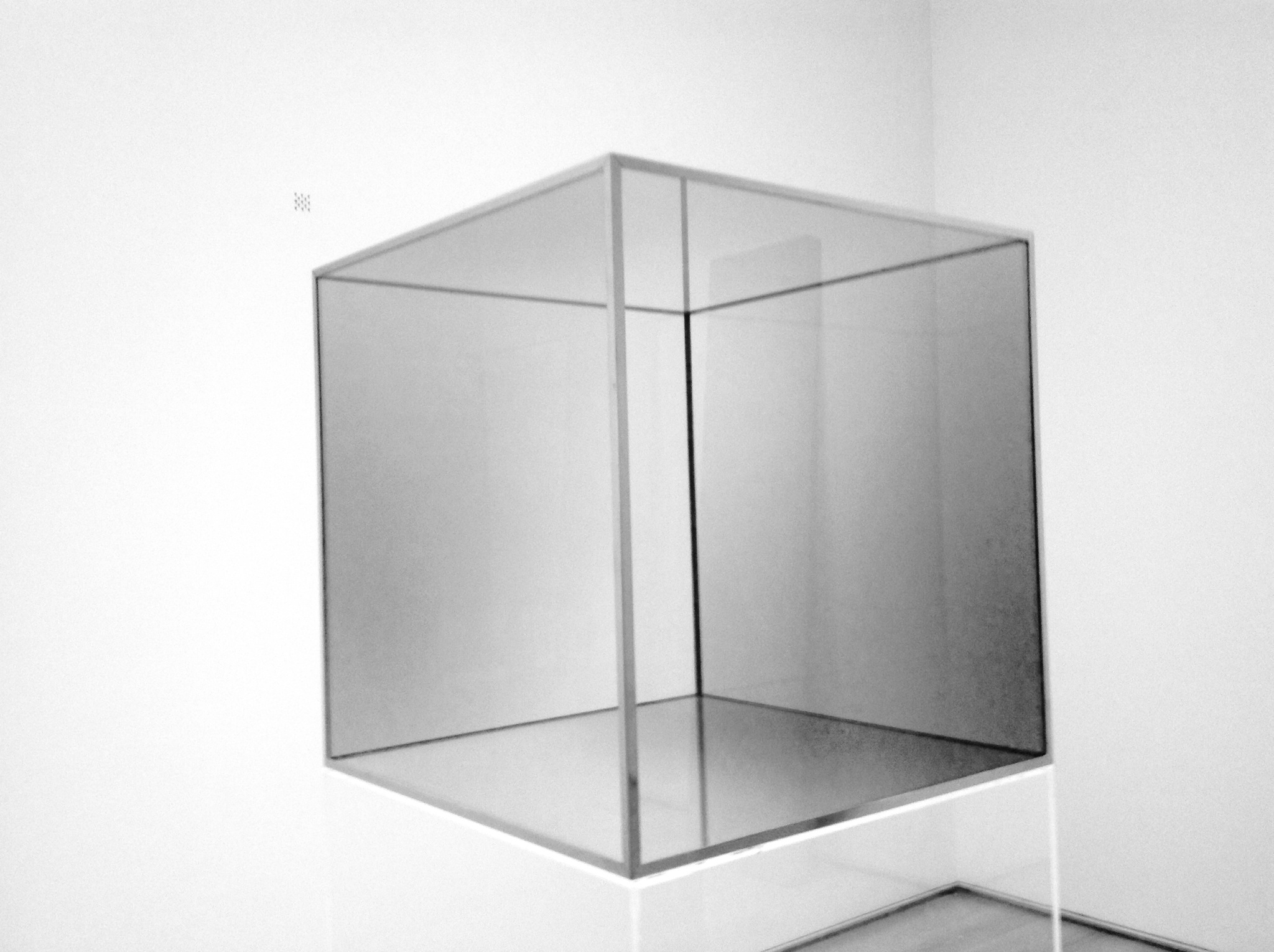
Can a cube be moving? Can you make a kinetic sonic sculpture combining, according to Jeff Koons all the human senses, of it?
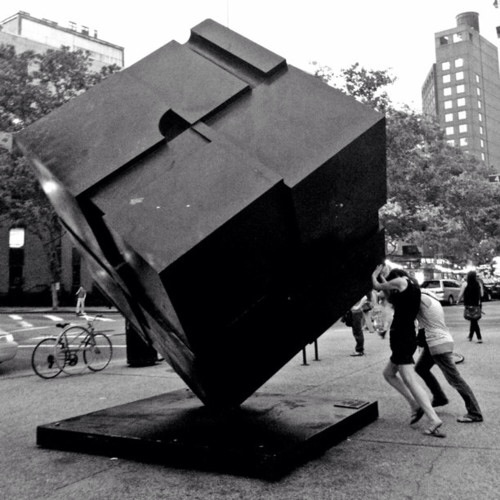
A cube the most immovable and stable figure. Tony Rosenthal, influenced by his teacher in Art Institute of Chicago, a cubist sculptor Alexander Archipenko, changes an angle and puts a cube on its edge. Thus Rosenthal creates a dancing cube – one of the most loved objects of kinetic public art and Village meeting place, that every second passer by won’t help spinning – almost as miraculous as a square wheel. Alamo (1967), or simply The Cube, was first installed for the six month and than was left at Astor Place according to the request of the population. In 2002, the writer Rick Moody produced a radio play about people obsessed with the work, and the following year, pranksters papered it with colorful cardboard squares to make it look like a giant Rubik’s cube.
Usually we would think of sculpture as something that is fixed to avoid change over time. However Tatlin, Rodchenko and Calder with their mobiles challenge the concept of motionlessness, questioned before by all the innovative art movements from impressionism to futurism. Tatlin sought to integrate art and life in service to the masses and believed an artistic vocabulary of abstract geometries best suited his aim
The black box, Alamo can be thought of as a 3D version of the greatest masterpiece of the XXth century. One of the interpretations of Malevich’s square as a human being comes from A Primer of the Higher Space by Claude Fayette Bragdon. This is known from sacral geometry and invisioned by Da Vinci in Homo quadratum – the Alamo Cube would be a superhuman then.
Thinking in this veins making the Cube speak would be a natural extension. The technology can be taught a vocabulary of several thousands of words so that it returns music whan these words are pronounced.
Poetry Cubes

Jason Nelson Poem Cube
It is getting better is a prototype of a poetry cube sonic sculpture. Since sonic sculpture is seen as a sonic ecology harmonizing artefact, the poem suggests primarily aesthetical means of organizing space, as opposed to consumerist accumulation of desired objects.
poetry by Natalia Fedorova
music by Taras Mashtalir
video by Alex Antipin
 Natalia Fedorova